
 If you have been injured on someone else’s property, you may quickly realize that simply proving a hazard existed is not enough. Under Georgia law, the core of a premises liability claim often rests on a specific legal concept: constructive knowledge.
At Davies Hothem Injury Law, our attorneys often have to prove that a property owner either knew about the danger or should have known about it through reasonable inspection. This brings us to a critical question: How do you prove how long a dangerous condition existed before your accident?
Understanding Constructive Knowledge in Georgia
Under Georgia Code § 51-3-1, property owners have a duty to exercise “ordinary care” in keeping their premises safe. If an owner claims they didn’t know about a spill, a loose floorboard, or a lack of security, your attorney must demonstrate that the condition was present for a sufficient length of time that a diligent owner should have discovered and corrected it.
In Gainesville, Georgia, where our local businesses and residential complexes see high foot traffic, property owners are expected to implement regular inspection protocols. When they fail to do so, we dig deep to find the evidence that tells the story of the hazard’s timeline.
Insider Evidence: How We Build Your Timeline
Proving the duration of a hazard is a detective game. Insurance companies are notorious for claiming that a spill “just happened” seconds before you walked by. We counter this by gathering specific types of evidence:
1. Surveillance Footage
Security cameras are the “gold standard” for proving how long a condition existed. If a spill occurred in a grocery aisle or a puddle formed in a parking lot, the footage can show exactly when it started. We know how to send formal “spoliation letters” to businesses to ensure they do not “accidentally” delete this video evidence after an incident.
2. Inspection and Cleaning Logs
Retailers and restaurants are often required to follow internal safety protocols, including regular “floor sweeps” or parking lot checks. If an employee logs their last sweep at 2:00 PM and you fell at 4:30 PM, we can argue that the owner failed to inspect the area for two and a half hours, establishing constructive knowledge.
3. Maintenance Requests and Repair Records
For hazards like broken steps or faulty lighting in apartment complexes, we look for past maintenance requests. If other tenants complained about a loose railing weeks before your accident, the property owner had actual notice. Even without direct complaints, we examine records to see if the owner ignored long-standing deferred maintenance.
4. Witness Testimony and Employee Schedules
Sometimes, the best evidence comes from people. An employee who was in the vicinity but failed to act, or a witness who noticed the hazard long before you arrived, can be pivotal. We also examine employee scheduling to determine if the property was understaffed, making it impossible for the owner to perform their required safety inspections.
5. Physical Characteristics of the Hazard
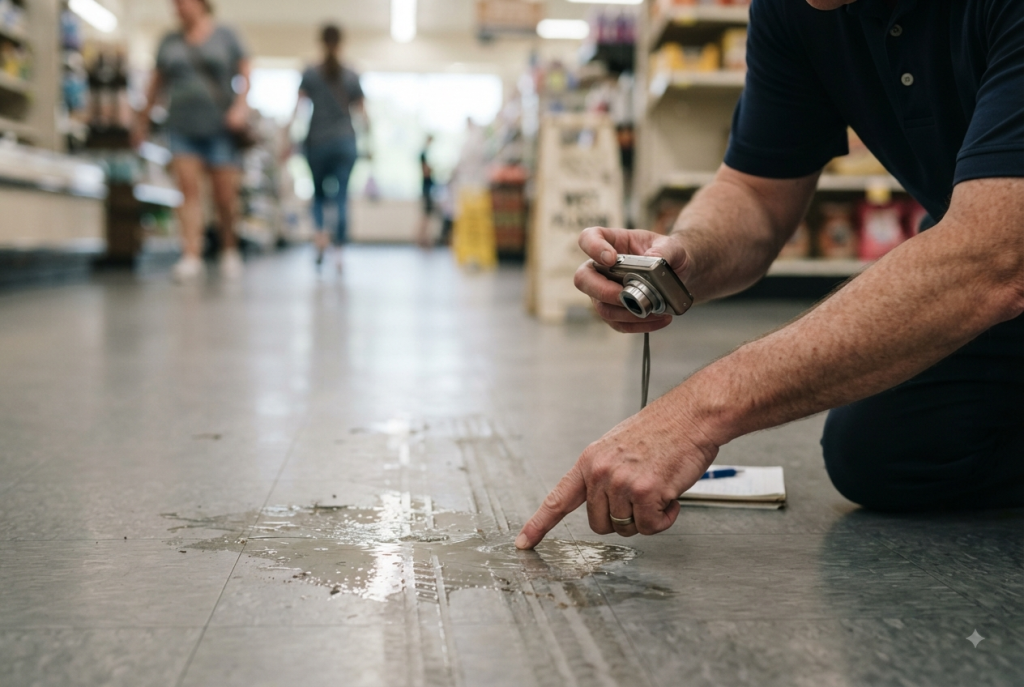
Believe it or not, the “look” of the danger matters. In a classic Georgia premises liability scenario, a puddle of liquid that is dirty, has tracks through it, or has begun to evaporate tells a story of time. These physical markers can indicate that a hazard has been present for a significant period.
The Reality of Premises Liability in Gainesville
Gainesville is a growing hub. From bustling retail centers on Dawsonville Highway to local apartment complexes, accidents occur more frequently than many residents realize. While many people focus on car accident statistics—which in Georgia show hundreds of thousands of crashes annually—premises liability injuries are equally life-altering. Whether it is a slip and fall in a retail store or an incident resulting from negligent security at a complex, these accidents often result in medical bills, lost wages, and permanent disability.
Property owners in Hall County are not shielded from responsibility just because they claim they “didn’t see” a hazard. If they failed to follow reasonable safety measures, the law is on your side.
Why Experience Matters
Proving how long a condition existed requires an attorney who understands the nuances of Georgia law and has the resources to conduct a thorough investigation. At Davies Hothem Injury Law, we don’t just take the property owner’s word for it. We fight for the evidence that proves negligence.
If you or a loved one has been injured, do not wait. Evidence like security footage and cleaning logs can disappear quickly. Contact a Gainesville premises liability lawyer today for a free consultation to discuss the specific facts of your case.
Disclaimer: This blog post is for informational purposes only and does not constitute legal advice. Premises liability laws in Georgia are subject to change and specific facts can significantly alter the outcome of a case. Please consult with an attorney at Davies Hothem Injury Law to discuss your unique situation. We represent clients throughout Georgia and are familiar with local Gainesville and Hall County ordinances and state statutes. Links provided to official state sites are for educational purposes.